PRIVATE PRACTICE · LICENSED UNDER THE GERMAN HEILPRAKTIKER ACT (PSYCHOTHERAPY) · BERLIN-CHARLOTTENBURG
When something can no longer be ignored.
Couples therapy and EMDR for individuals and couples. The aim is to understand what connects, process distressing experiences and be able to act again rather than only react.
Private practice, self-pay: sessions are not covered by German statutory health insurance.
English and German · in person and online · Deutsch
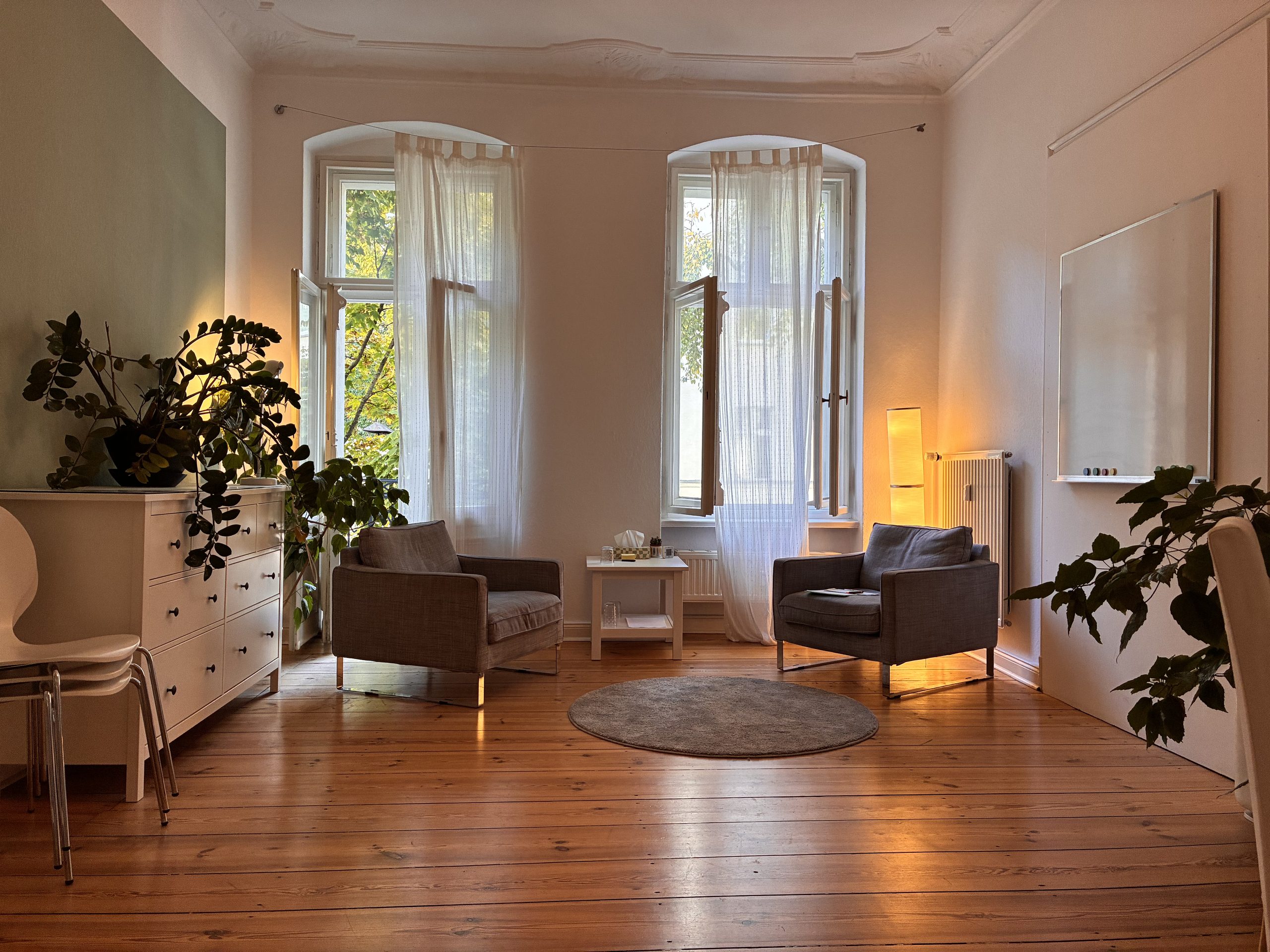
01 / 07
Two areas of focus
FOR COUPLES
Couples therapy
When conflicts keep repeating and, in conversation, you tend to defend yourselves or withdraw instead of reaching each other. Within a set framework of a joint first session, individual sessions and couples sessions.
Couples sessions 80–85 min · also as a package · experience with queer and intercultural couples
FOR INDIVIDUALS
EMDR and trauma work
A structured, scientifically recognised method for processing traumatic experiences.
First EMDR session 80–85 min · follow-ups 50 or 80 min
02 / 07 · Approach
Not: what is wrong with you?
My work is guided by the Power Threat Meaning Framework (PTMF), an alternative to diagnostic manuals. It asks how power operates in a person’s life and what threats arise from it. Symptoms are seen as understandable reactions, not as defects.
Respect without judgement · cultural sensitivity · clarity, resonance, understanding
1. What has happened to you?
2. How did it affect you?
3. What sense did you make of it?
4. What did you have to do to survive?
5. What are your strengths?
03 / 07 · Shame
What is hardest to talk about.
Shame often arises where people were belittled, exposed or left alone with expectations. It rarely shows directly, but as withdrawal, irritability, perfectionism or the sense of having to handle everything alone.
Most feelings point outward: fear towards a threat, sadness towards a loss, anger towards a violation. Shame points inward. It does not say “I did something wrong”, but “I am wrong”.
The psychoanalyst Léon Wurmser describes shame as a protection against the fear of being held in contempt. That is why it pushes us to hide whatever feels shameful, and this is what makes it so persistent: shame can only heal in relationship, where we are seen clearly without being held in contempt, mocked or rejected. Yet for someone who feels ashamed, that is exactly the experience that feels most dangerous.
In relationships
When every wish of the other person is experienced solely as an attack and anger or silence follows.
After distressing experiences
When the feeling remains that you failed or that it was your own fault.
Taking the first step
When even asking for support already feels like weakness.
04 / 07 · Couples therapy
“We love each other. But something keeps getting in our way, and it is stronger than us.”
Couples therapy is neither communication training nor a courtroom. The question is not who is to blame, but which pattern keeps repeating between you, and why.
I work systemically, with elements of emotionally focused couples therapy. By the end it should be clear whether and how change is possible and what your next step could look like.
The dynamic
Which behaviour triggers which, and what function does it serve for each of you?
The imprints
Where do experiences from your families of origin weigh so heavily that you no longer see each other?
The perspective
What connects and carries you, what is compatible, what is not? And what follows from that in practice?
Often both partners struggle with the same issue but learned early on to avoid it in different ways. What first feels like strong attraction holds the potential for hurt, but also for real connection.
Step 1 · 50–55 min
Joint first session
Clarifying your concerns and checking together whether we are a good fit.
Step 2 · 50–55 min
Individual sessions
At least one with each partner, more if needed.
Step 3 · 80–85 min
Couples sessions
Back together, at intervals that suit you.
Common reasons to come
Escalating arguments · Imbalance of giving and taking · Closeness and distance, on-off dynamics · Ambivalence · Breaches of trust · Sexual conflict or low desire · Family of origin and partnership · Blended families · Co-parenting after separation · Dealing with affairs · Dealing with addiction · Loss of equal footing · Jealousy
05 / 07 · EMDR
When the past feels like now.
EMDR (Eye Movement Desensitization and Reprocessing) is a structured psychotherapeutic method for processing highly distressing experiences.
It was developed by Francine Shapiro in the late 1980s, has been studied extensively and is recommended in international and German guidelines for the treatment of post-traumatic stress disorder.
THE UNDERLYING MODEL (AIP, ADAPTIVE INFORMATION PROCESSING)
Processing
Experiences are usually processed so they can be filed as past: they happened, but are no longer an immediate threat.
Interruption
When an experience exceeds what a person could cope with at the time, it is stored dysfunctionally. Images, body sensations, emotions and negative self-beliefs stay “frozen” and the nervous system keeps treating them as a current threat.
Reprocessing
In treatment, the memory is deliberately activated and combined with bilateral stimulation through guided eye movements, so that the nervous system no longer responds with an acute threat reaction.
How it works
First session · 50–55 min
Getting to know each other, taking a history and clarifying whether EMDR suits your concern. You can fill in the intake form (PDF, German) beforehand.
First EMDR session · 80–85 min
With sufficient time for stabilisation, including imagery exercises. If possible, avoid demanding commitments for the rest of the day.
Follow-up sessions · 50 or 80 min
Usually weekly. For a single, clearly defined event 3 to 5 sessions may be enough; for repeated distressing experiences 10 or more are realistic.
When EMDR is not suitable, or only later
- severe cardiovascular conditions and eye conditions
- acute psychosis or manic episodes
- acute suicidality or lack of affect regulation
- severe addiction without stabilisation
Further reading: De Jongh et al. (2024): State of the science, EMDR therapy

06 / 07 · About
Sophie Mautner
- Heilpraktikerin für Psychotherapie
State licence to practise psychotherapy under the German Heilpraktiker Act, issued by the Berlin health authority Kreuzberg-Tempelhof - B.Sc. Health Sciences / Public Health
Charité Universitätsmedizin Berlin - MSc Psychology, in progress
Arden University, BPS-accredited · expected completion 2027
I work mainly with the PTMF and with systemic and hypnosystemic approaches; with couples I also use methods from emotionally focused couples therapy.
Further training: including with Dr. Gunther Schmidt and Prof. Dr. Christian Roesler
EMDR: Institut Christoph Mahr
Coaching: Arche Medica Berlin
Publication: AI in medical documentation (BDC, German)
07 / 07 · Fees
Fees
Private practice, self-pay. German statutory health insurance does not cover the costs. As a self-paying client, you decide whether any information about your treatment goes to an insurer.
Individuals
Billed by time, the same for first sessions, talk sessions and EMDR.
- Individual session · 50–55 min · €95
- Long individual session · 80–85 min · €150
Couples
- First session · 50–55 min · €110
- Couples session · 80–85 min · €170
- Individual session within couples work · 50–55 min · €95
Couples package: €850
4 couples sessions of 80–85 min and 2 individual sessions of 50–55 min, scheduled at intervals of your choice
Private health insurance and supplementary insurance may reimburse individual sessions depending on your plan. Couples therapy is not reimbursed. Cancellations less than 24 hours in advance may be charged (§ 615 BGB). FAQ (German)
Book a first session
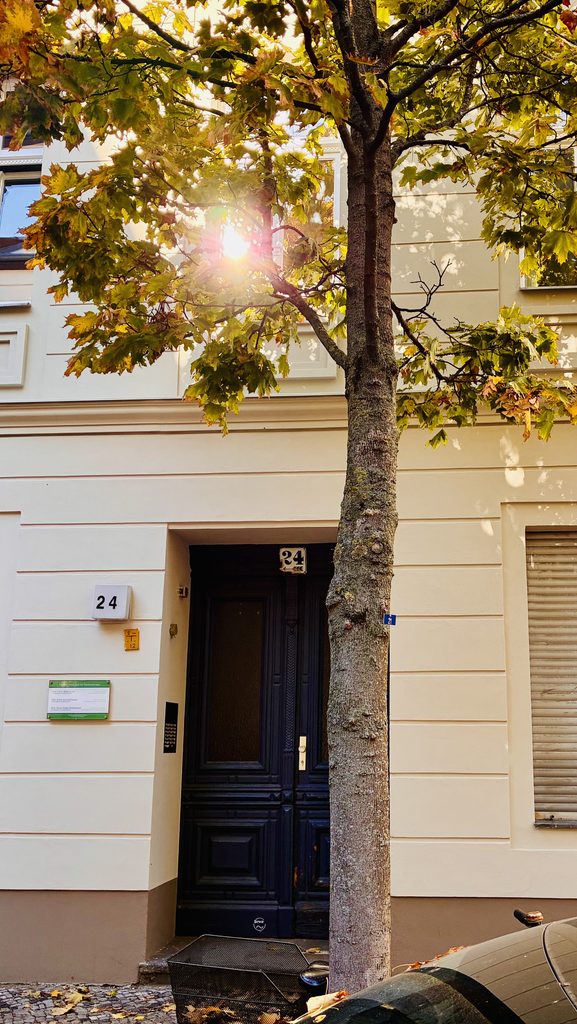
Haubachstraße 24 · 10585 Berlin-Charlottenburg (Google Maps) · also online · English and German
I work in a shared practice. Please ring the bell marked “Praxisgemeinschaft für Psychotherapie”.
or by email: s.mautner@outlook.de
Please only send appointment requests by email, no details of your concerns (emails are not encrypted).
In an acute crisis or emergency: call 112.
Berlin Crisis Service (Berliner Krisendienst), 24/7 and anonymous: Region West, Horstweg 2, 14059 Berlin-Charlottenburg, phone 030 39063-20.
Further support (German)